Chicken Surprise (silly joke)

Rhoda and Harry go for a meal at a Chinese restaurant and order the Chicken Surprise.’ The waiter brings the meal, served in a lidded cast iron pot. Just as Rhoda is about to serve herself, the lid of the pot rises slightly and she briefly sees two beady little eyes looking around before the lid slams back down.

‘Good grief, did you see that?’ she asks her husband, Harry. He hadn’t, so she asks him to look in the pot. Harry reaches for it and again the lid rises, and he sees two little eyes looking around before it slams down. Rather perturbed, he calls the waiter over, explains what is happening, and demands an explanation.

‘Please sir,’ stammers the waiter, ‘what you order?’
Harry replies, ‘Chicken Surprise.’
‘Ah! So sorry, is mistake,’ says the waiter, ‘I bring you Peeking Duck!’

Hayao Miyazaki and the Marnie Poster – does the old man have a point?

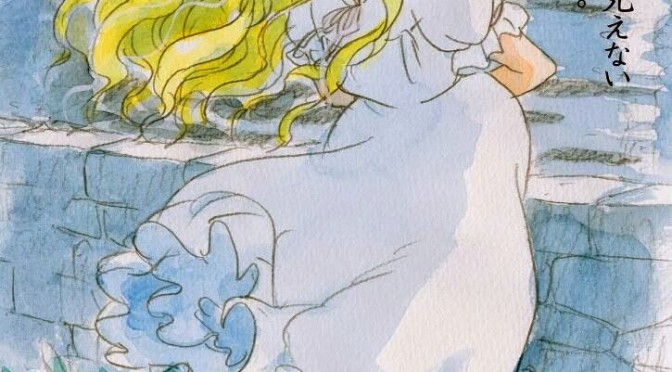
The news made the rounds last week that Hayao Miyazaki had issues, to put it mildly, with the promotional poster for Studio Ghibli’s latest offering: When Marnie Was There.

I’m still trying to wrap my head about what exactly his problem is with this particular movie poster. According to reports, Miyazaki says using pictures of a girl to get attention is “just plain outdated and cheesy.” Uhh, what? Just in case I was reading him wrong, I went back and looked at older Ghibli posters: Spirited Away, Princess Mononoke, Ponyo, Nausicaa, Arrietty. They all feature the main girl quite prominently on their covers. Perhaps not in as enticing a pose as Marnie, but prominently nevertheless.

So what exactly is Miyazaki protesting against? The very-slightly suggestive pose Marnie is striking? It’s a typical “cute girl being friendly” anime pose, but hardly as ‘come hither’ as some anime can get. Perhaps he wanted to see her standing straight up and stock still like girls in his other covers, but that doesn’t means a 15-degree tilt in posture is enough to ruin the whole idea.

Or is the problem her hair and eyes? Blonde and blue-haired foreigners in anime are often – not always, but often enough – portrayed as wild, lascivious, uncontrolled sexpots. Thus by virtue of her nationality, Marnie is already in the over-sexualized category, at least in Miyazaki’s eyes, meaning that any slight friendliness on her part can be mistaken as an overt come on. This is especially so because one of the earlier posters had “I love you” written on it. This isn’t his official opinion, by the way. I’m just trying to get into Miyazaki’s head on this issue.

Really, though, I think the truth behind the issue: money. Controversy sells. This is the first Ghibli movie to be released since Miyazaki retired (again), and maybe the studio felt they needed a little extra oomph behind their marketing. What better way to ride on the maestro’s coattails while ostensibly breaking with the past than by releasing critical – but not too critical – comments from the guru himself? I won’t go so far as to say they made up the comments for publicity’s sake, but they certainly promoted them enthusiastically enough.

When Marnie Was Here comes out in Japan in July 2014 and in the rest of the world not too long afterwards. I’m quite looking forward to it, though I still have to watch Arrietty and The Wind Rises first.
Gamushara manga review

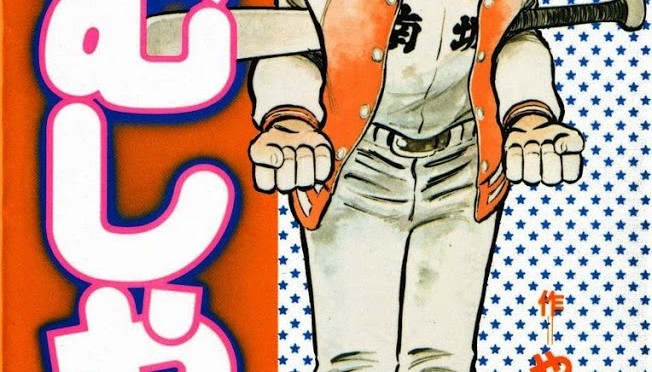
Another terrible manga from the terrible duo of Juhzo Yamasaki (writer) and Mitsuru Adachi (artist). Adachi has produced several all-time classics since he struck out on his own, but his early artist-only series SUCK.

I only finished Gamushara (がむしゃら) a few days ago, but I’ve already forgotten all the character names. It is completely unremarkable and not really worth a read, not even by someone like me who is currently grabbing any and all baseball manga I can get my hands on. By the way, all manga reviews on this blog will contain free, unmarked spoilers so, yeah. I probably should have said that earlier.
Anyway, the main guy on the cover there is a transfer student at a high school. He gets into an altercation with the guys on the regular baseball team and decides to form a softball team so he can go to the national softball tournament. As with many baseball series (e.g. Princess Nine, Taisho Yakyu Musume), a ridiculous amount of time is spent early on gathering members, even more time is wasted on some stupid rivalry and then the main character’s team loses the final match of the series but learns valuable lessons from it.

It’s a standard pattern, but in the case of Gamushara it rankles quite a bit because the main character is way off base. He is 100% in the wrong and probably has some serious personality problems. He picked the fight with the baseball team for no good reason and formed his own team largely to get back at them. Throughout the series he goes out of his way to antagonize and annoy them, yet somehow he’s treated as a hero for his pettiness. It’s very hard to swallow, which is why I took to skipping large chunks of volume 2. At least it was short, that’s all I have to say. I can’t think of a single redeeming feature of Gamushara, because even the baseball sections were boring, poorly-written and predictable. Another manga for hardcore Adachi fans only, I guess.

Taisho Yakyuu Musume anime review

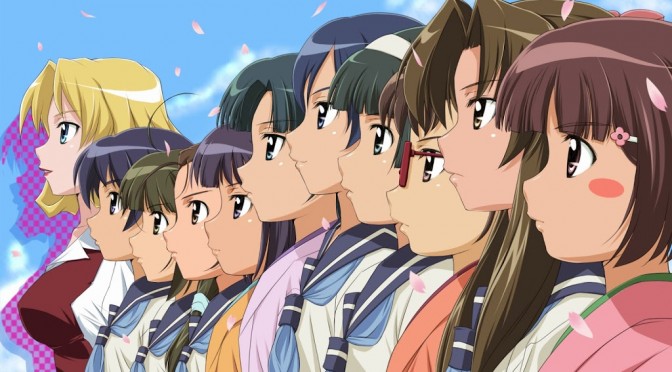
Moderately interesting baseball slice of life anime set in 1920s Japan. Rich girl’s fiancee says something mean and she forms a baseball team to get back at him. The girls seem to be having fun, at least, and there are all the different kinds of wacky misunderstandings and romantic mix-ups that you would expect from your everyday high school anime.
I didn’t find Taisho Yakyuu Musume interesting enough to watch till the end, so I stopped around episode 10 and just skimmed through the rest. I’m happy that Koume’s relationship with Saburo seems to be going along well. Apart from that, I didn’t care to watch any more. Nice characters, but nothing you haven’t seen before from any moe slice-of-life show. The baseball action isn’t very good because for most of the show the girls really suck at it. The pitcher only learns to throw a breaking ball around episode 8 of 12, etc. etc. Worth a watch if you like high school girls, moe, or slice of life.
Spoilers: Most baseball anime series end with the protagonist’s team losing. This ratio goes up to 100% when it’s a show about girls facing off against boys. Heaven forbid that XX chromosomes should ever triumph over XY. Keep that in mind when you watch this.

Little Boy manga review

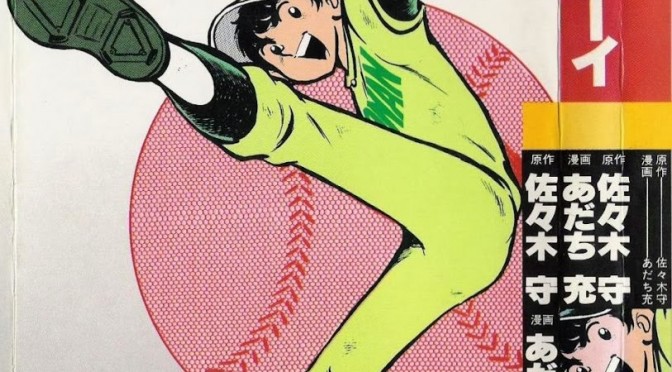
Little Boy is a miserable excuse for a manga. Its only redeeming feature is that it’s about baseball. And I suppose there might be points of interest for Mitsuru Adachi fans, since he drew the art for this series. Since this manga came out in 1974, early in Adachi’s career, it might be interesting to people seeking to trace the evolution of his art, before he settled on the same few character archetypes and evidently decided, why fix what ain’t broke? The story is by Mamoru Sasaki, who I’d never heard of before and hope to never hear of again.
I’ll skip lengthy explanations of the story and characters because it really doesn’t deserve it. I’ll just say it gets worse and worse as the series progresses and it’s a good thing Little Boy only lasted one volume. Gou, the main character only gets more and more difficult, rude, selfish and impossible to root for. In many series this is balanced out by letting you root for the rival instead, but all the “rivals” in this series show up for only a few pages a chapter to lose unceremoniously to Gou’s overwhelming skill and power. The one match he does lose isn’t satisfying either, because he isn’t that torn up over it. He’s just like, welp, gotta work harder. Typical shonen hero.

little_boy_034His ‘girlfriend’ Michi isn’t worth writing home about either. Gou threw one bloody ball (literally) which landed near her, and that makes her go all “I’ll follow you forever!” Michi even kicks up a stink when Gou agrees to marry another girl so the other girl can teach him a secret pitch (because that’s the kind of guy Gou is. He sucks.) The question of what she sees in him is never, ever answered. Unless it has to do with their mutual fetish for public peeing (yes, you read that right). Every Jack has his Jill, as the saying goes.

For the reasons I’ve mentioned above, Little Boy has zero merit as a romance or character-based manga. More importantly, because of the monotony of the matches, the nastiness of Gou and the colorlessness of the opposing batters, it has zero merit as a sports manga as well. The art is actually decent for a manga that old, and the action is always simple and easy to follow, but that’s as far as it goes for the positive side of this manga.